If your heel hurts on the first steps out of bed, or aches after a shift on your feet, or stops you at the same point of every run along the Clontarf seafront, this guide is for you. Heel pain is the problem we assess more than any other at our Dublin clinic, and it is also the problem that has usually been treated wrongly for the longest by the time we see it. Months of rest, a drawer full of shop-bought insoles, advice to stretch harder. Rarely a diagnosis.
That last word is the whole point of this guide. Heel pain is a symptom, not a diagnosis. There are at least six common causes, they produce confusingly similar symptoms, and they need different and sometimes opposite treatment. A stress fracture needs load taken off it. A tendinopathy needs load added progressively. Guess wrongly and the pain simply continues, which is why so much heel pain lasts months when the tissue itself could have settled in weeks.
A note on what this is not. This guide will help you understand what is likely going on and what is safe to start doing now. It cannot confirm a diagnosis. If your pain does not match the patterns below, wakes you at night, or came on with a sudden pop, skip ahead to the red flags section and get assessed.
Darren runs the specialist clinic at Body Med, Clontarf, with on-site diagnostic ultrasound. Paul founded Lower Limb in Belfast in 2011 and leads the clinical pathway and the Réalta Labs orthotics facility, where every Lower Limb orthotic is designed and 3D-printed in-house.
Why heel pain lingers for months
Most heel pain gets labelled plantar fasciitis on day one, because plantar fasciitis is the most common cause. The label is right roughly seven times out of ten. The problem is the other three, because the treatments that help fascia pain do very little for a fat pad problem, nothing for a nerve entrapment, and can actively harm a bone stress injury.
The tissue biology matters too. The structures that cause heel pain are mostly slow-metabolising connective tissues: fascia, tendon insertion, bone. They adapt to load over weeks, not days. That cuts both ways. It means there is no honest overnight fix, and it means that a correctly targeted plan almost always produces meaningful change within six to twelve weeks. When pain has already lasted six months, it is nearly always because the plan was aimed at the wrong tissue, not because the tissue cannot heal.
Dublin gives us a particular mix. Runners building for the autumn marathon on the concrete of the coast road. Parkrunners at St Anne's who jumped from 5k to 10k in a month. GAA players back to hard pitches after a break. Nurses, chefs and retail staff on unforgiving floors for ten-hour shifts. Kids at summer camps with growth-plate heel pain their parents are told is "growing pains". Different causes, same word: heel pain.
The six causes of heel pain
1. Plantar fasciitis (plantar fasciopathy). Sharp pain under the inside front of the heel, worst on the first steps in the morning, easing as you move, returning after rest or after a long day. Despite the name, modern imaging shows this is usually degenerative thickening of the fascia at its heel attachment rather than simple inflammation, which is why anti-inflammatories alone rarely fix it.
2. Insertional Achilles tendinopathy. Pain at the back of the heel where the tendon anchors to the bone, stiff first thing, aggravated by hills, stairs and speed work. Often mistaken for fascia pain because both are worse in the morning. The location is the giveaway: back of the heel, not underneath.
3. Heel fat pad syndrome. A deep, bruise-like ache in the centre of the heel, worse barefoot on hard floors and often worse with standing rather than walking. The heel's natural shock absorber has thinned or been irritated, and it needs cushioning and protection, not stretching. This is the cause most often mislabelled as stubborn plantar fasciitis.
4. Calcaneal stress fracture. Bone stress injury of the heel bone itself, typically after a rapid increase in running volume or a return to impact after time off. The pain builds with activity rather than easing, and squeezing the heel bone from both sides is sharply painful. This one changes everything: it needs offloading, and loading it harder makes it worse.
5. Nerve entrapment (Baxter's nerve). Burning, tingling or electric pain along the inside of the heel that does not follow the classic first-steps pattern and does not respond to standard heel treatments. Frequently found in longstanding "plantar fasciitis" that has failed every treatment, because the nerve was the problem all along.
6. Sever's disease (children 8 to 14). Growth-plate irritation at the back of the heel in active kids, classically during a season of hard-pitch training or a jump in activity. Self-limiting and very manageable with load adjustment, but it deserves a proper assessment rather than a shrug, because stress fractures and inflammatory causes exist in children too.
The two-minute self-check
Three questions sort most heel pain into a likely category. This does not replace imaging, but it tells you which pattern you are probably in and what is sensible to try first.
Where exactly is it? Press around and be precise. Under the heel towards the inside front points to the fascia. Directly under the centre, like a stone bruise, points to the fat pad. The back of the heel points to the Achilles insertion or, in a child, the growth plate. The inside wall of the heel with burning or tingling points to the nerve. Deep in the bone and sore when you squeeze the heel from both sides points to bone stress.
When is it worst? Worst on first steps and after rest, easing with movement: fascia or Achilles insertion. Worse the longer you stand, especially barefoot on hard floors: fat pad. Building steadily during activity and worse afterwards, session on session: think bone stress and stop loading it until it is assessed.
What set it off? A jump in running volume, a switch to harder surfaces, a season change to hard pitches, new flat footwear, a lot more standing than usual, or in kids a busy sports camp. The trigger usually names the tissue: impact spikes load bone and fascia, standing loads the fat pad, hills and speed load the Achilles.
What is safe to do in the first two weeks
Whatever the cause turns out to be, the following are low-risk, evidence-aligned first steps that will not make any of the six causes worse, with one exception we flag below.
Manage the load, don't zero it. Complete rest deconditions the tissue and rarely fixes the problem. Reduce the aggravating activity to a level that keeps pain at or below a 3 out of 10 during and after, and keep moving otherwise. For runners that usually means cutting volume and intensity, not stopping, unless bone stress is suspected.
Change the surface equation. Supportive, cushioned footwear worn consistently for two weeks, including in the house, takes real load off every structure in the heel. Hard floors barefoot are the single most common aggravator we see in Dublin kitchens, wards and shop floors.
Load the calf gently. For pain under the heel or at the Achilles, slow calf raises to a comfortable level, every second day, begin the loading process that fascia and tendon both ultimately need. Mild discomfort during is acceptable; pain that is worse the next morning means you did too much.
The exception: suspected bone stress. If the pain builds with activity, is sore on the heel squeeze, and followed a clear spike in impact volume, do not "train through it" and do not start calf loading. Offload and get assessed. Bone stress caught early is a six-week problem; caught late it can be a six-month one.
If two weeks of this produces no meaningful change, or the pain is getting worse inside that window, the answer is not a harder version of the same self-care. It is a diagnosis.
When self-care is the wrong plan
Book an assessment promptly, rather than experimenting further, if any of these apply:
- Heel pain that has already lasted more than six to eight weeks despite sensible self-care
- Pain that is worsening week on week, or building during activity rather than easing
- Sharp pain on squeezing the heel bone from both sides
- Burning, tingling, numbness or electric shooting pain
- Night pain, or pain present at complete rest
- A sudden pop or tearing sensation at the moment it started
- Heel pain with swelling, heat, redness, fever or feeling unwell
- Heel pain in a child that causes limping or pulls them out of sport
- You have diabetes, inflammatory arthritis, or take long-term steroids
How we confirm the cause in one visit
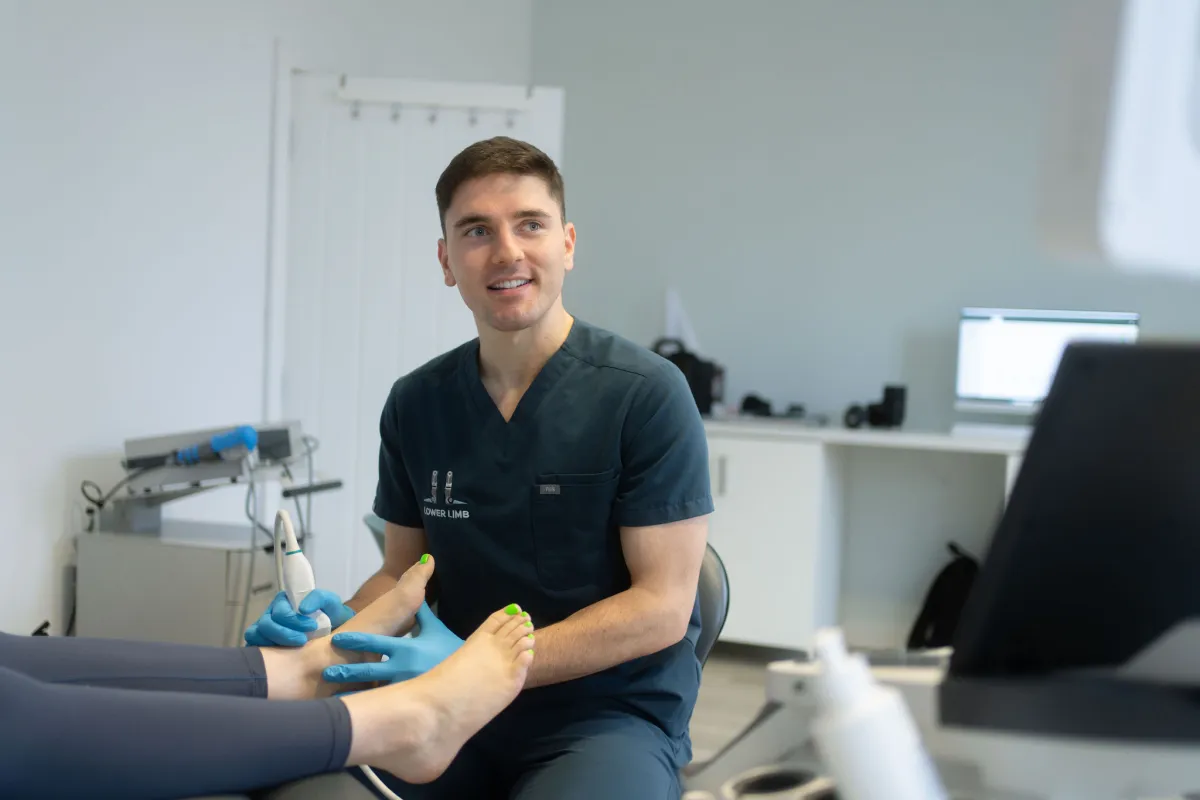
Our Diagnostic Injury Assessment at Body Med, Clontarf is 45 minutes and is built to answer one question definitively: which tissue is producing your pain. It combines a structured clinical history, hands-on testing, clinical gait and biomechanical assessment, and on-site MSK diagnostic ultrasound in the same appointment, carried out by a podiatrist of the Royal College of Physicians and Surgeons of Glasgow with masters-level training in biomechanics and sports medicine.
The ultrasound is the part that removes the guesswork. A healthy plantar fascia measures under about 4 millimetres at its insertion; a fasciopathy shows measurable thickening and darker, disorganised tissue at exactly the point that hurts. The Achilles insertion, the fat pad, and the soft tissue around Baxter's nerve each have their own distinct appearance. Where bone stress is the concern, ultrasound findings plus the clinical picture tell us when an MRI referral is genuinely needed, and we arrange that pathway directly rather than sending you back to the start of the queue.
You leave the same appointment with a confirmed working diagnosis, an honest explanation of timescales, and a written plan matched to the actual tissue: progressive loading for fascia and tendon, offloading and protection for fat pad and bone, targeted treatment for nerve irritation, and load management for growing heels. Where mechanics are driving the overload, we prescribe custom orthotics designed and 3D-printed as a pair at our own lab, Réalta Labs, rather than bought in from a third party. No referral is needed, and the assessment is €160 including the ultrasound.
The treatment ladder for each cause, the six-week plan we hand to patients, the footwear matrix and the return-to-running progression are in the PDF version of this guide below. They are the exact documents we use in clinic, and they are free in exchange for your email.