Shin Splints (MTSS)
Shin pain in runners is common. The key question is whether it is shin splints or a stress fracture.
We work out where you sit on the bone stress continuum, then build a return to running around the cause, not just the pain.
Shin splints and stress fractures sit on the same spectrum
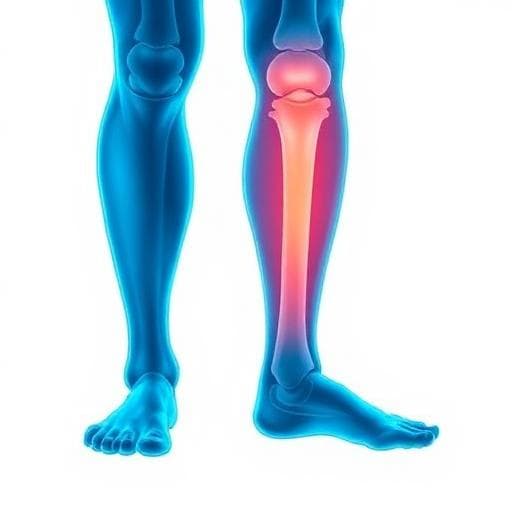
"Shin splints" is the everyday name for medial tibial stress syndrome (MTSS). It is exercise-related pain along the inner border of the shinbone, usually over the lower two-thirds. It is thought to reflect a stress reaction where the deep calf fascia attaches to the bone, when load builds faster than the bone can adapt.
MTSS is at the early end of what is called the bone stress continuum. If loading keeps outpacing recovery, the same process can progress to a tibial stress fracture. Telling the two apart matters, because the management and timescales are different.
- MTSS: a diffuse ache along 5 cm or more of the shin border. It often eases once warmed up and aches afterwards. Frequently both legs.
- Tibial stress fracture: sharp, focal pain in one spot that gets worse as the run goes on, pain on hopping, and sometimes pain at rest or at night.
Other causes of lower leg pain include chronic exertional compartment syndrome, where pain comes on at a predictable point in a run and settles fully with rest, and less commonly nerve or blood vessel problems. Common contributors across all of these are sudden jumps in mileage, hard surfaces, low running cadence, reduced calf strength and low energy availability. For a broader look at bone stress injuries in the foot and leg, see our stress fractures page.
Pain on the front of the shin needs prompt attention
Focal pain on the front edge of the tibia, particularly in jumping athletes, can indicate a higher-risk stress fracture that heals less reliably. Stop running and book an assessment promptly rather than training through it.
Common symptoms
Find the cause, not just the sore spot
Your assessment is with Darren Costello, a CORU-registered podiatrist with an MSc in Sports and Exercise Medicine and a CASE-accredited postgraduate certificate in MSK ultrasound.
We map the length and location of tenderness, use hop and loading tests, and go through your training history, recent changes and general health. MSK ultrasound lets us look at the surface of the bone and surrounding soft tissue on the day. Where a stress fracture is suspected, we explain whether MRI is needed to confirm and grade it.
We also look at how you run: cadence, foot strike, foot posture and single-leg control. These are the things that can be changed so the problem does not come back.
Diagnostic Injury Assessment
The right starting point for shin pain. 45 minutes, €160, includes MSK ultrasound and a return-to-running plan.
How we manage shin splints
Most shin pain responds to a combination of load management, strengthening and targeted changes to how you run.
Load Management
Reducing running to a level that keeps pain low, with cross-training to maintain fitness. Complete rest is only needed where a stress fracture is confirmed or strongly suspected.
Learn moreStrength Rehabilitation
A prescribed programme of calf, soleus, foot and hip strengthening, progressed as symptoms allow, so the leg can tolerate running load again.
Learn moreRunning Technique and Return to Run
Small changes such as a modest increase in cadence can reduce load on the shin. A graded walk-run programme then rebuilds volume before pace.
Learn moreCustom 3D-Printed Orthotics
Where a markedly pronated foot posture is contributing, arch-supporting orthotics can reduce strain on the inner shin. Always supplied as a pair, following an assessment.
Learn moreIf hands-on physiotherapy would help alongside your plan, we can refer you to the physiotherapy team at Body Med in the same building. Runners with flat feet may also find our page on flat feet and tibialis posterior problems useful.
Frequently asked questions
Can I keep running with shin splints?
Sometimes, with reduced volume, if the pain is mild and settles quickly. If pain builds during a run, lingers the next day, or is sharp in one spot, stop running and get it assessed, because that pattern points more towards a bone stress injury.
How long do shin splints take to settle?
It depends on how far along the bone stress continuum you are. Early MTSS can settle within a few weeks of load adjustment and rehab. A tibial stress fracture takes longer and needs a more gradual return. We give you a timeline based on your findings rather than a generic estimate.
Will new running shoes fix it?
Rarely on their own. Shoes are one factor among several. Training load, running technique, strength, bone health and foot mechanics all play a part. We look at all of them so the change you make is the one that matters for you.
Do I need an MRI?
Not always. Many cases can be diagnosed clinically. If the history and examination suggest a stress fracture, or symptoms are not settling, MRI is the preferred test to confirm and grade it, and we advise you on the right route to get one.
Can I claim on my health insurance?
Many VHI, Laya healthcare and Irish Life Health plans include a day-to-day benefit for podiatry visits. You pay on the day, we give you an itemised receipt, and you claim it back through your insurer. See our insurance page for what plans typically pay.
More on claiming: health insurance for podiatry in Dublin.