Foot drop? Collapsing arch? Richie Brace AFOs in Dublin
Custom, hinged ankle foot orthoses for foot drop and adult acquired flat foot, 3D scanned and fitted to your own foot and leg.
Assessed and fitted by specialist podiatrist Darren Costello at 188 Clontarf Road. No referral needed.
What is a Richie Brace?
An ankle foot orthosis (AFO) is a brace that spans the foot and ankle to control how they move. Traditional AFOs are rigid plastic shells up the back of the calf: they work, but they are bulky, need oversized shoes and block the ankle, so many people stop wearing them.
The Richie Brace is a moulded foot orthotic joined to two lightweight uprights and a calf cuff, hinged at the ankle. It is shorter and lighter, fits inside most lace-up shoes, and lets the ankle bend while it controls the problem movement: either the foot dropping, or the heel and arch collapsing inwards.
Two conditions, two versions of the brace
Foot drop: Richie Brace Dynamic Assist
Foot drop is weakness of the muscles that lift the front of the foot, so the toes catch, you trip, or the foot slaps down. The Dynamic Assist has two sprung ankle hinges that lift the foot by up to 15 degrees as you step through, so the toes clear the ground, while the ankle still moves naturally. Common causes include a common peroneal nerve injury at the knee, an L5 nerve root problem in the lower back, stroke, multiple sclerosis and Charcot-Marie-Tooth disease.
Adult acquired flat foot: standard Richie Brace
When the posterior tibial tendon on the inside of the ankle fails, the heel rolls in and the arch slowly collapses. This is adult acquired flat foot, also called posterior tibial tendon dysfunction (PTTD) or progressive collapsing foot deformity. The fixed Richie Brace holds the heel and arch in a better position and takes strain off the tendon, while the ankle hinge still lets you walk normally.
New foot drop always needs its cause investigated. If it came on suddenly, or with back pain and numbness, see your GP or an urgent care service first. A brace manages the walking problem; it does not replace finding out why the nerve or muscle has stopped working.
Why staging matters, and what the evidence says
Typical signs are pain and swelling along the inside of the ankle, a foot that looks flatter than the other, more toes visible on the outside when seen from behind, and difficulty rising onto tiptoe on that leg. Treatment depends on the stage:
- 1
Early: tendon pain, foot shape unchanged
Custom foot orthotics and a structured strengthening programme are usually enough.
- 2
Flexible: arch collapsing but still correctable
This is where a custom AFO such as the Richie Brace earns its place, because an orthotic alone often cannot control the heel.
- 3
Rigid: deformity no longer correctable
A brace is used for support and pain relief rather than correction, and a surgical opinion is usually discussed.
In a study by Alvarez and colleagues (Foot & Ankle International, 2006), 47 patients with early and flexible posterior tibial tendon dysfunction were treated with an orthosis, including a short articulated AFO, plus a daily strengthening programme. 83% had a successful outcome at a median of four months. A randomised trial by Kulig and colleagues (Physical Therapy, 2009) found orthoses combined with progressive resistance exercise reduced pain and improved function in early PTTD.
The message from both: a brace works best with exercise, not instead of it.
When the Dynamic Assist is not the right brace
- Strong calf spasticity or clonus, where a spring cannot overcome the muscle and a more rigid AFO is usually better
- A stiff ankle that cannot be brought up to neutral by hand
- Large swelling that changes from day to day
- Reduced sensation with a high risk of skin breakdown, which needs very careful fitting and skin checks
If one of these applies, we will tell you at your assessment and suggest the right alternative or referral.
How we fit a Richie Brace in Dublin
- 1
Assessment
History, gait analysis, strength and range of motion testing, and on-site ultrasound of the posterior tibial tendon where flat foot is the issue.
- 2
3D scan
A digital scan of your foot and lower leg. No plaster.
- 3
Manufacture
Your brace is built to prescription: fixed for flat foot, or Dynamic Assist for foot drop.
- 4
Fitting
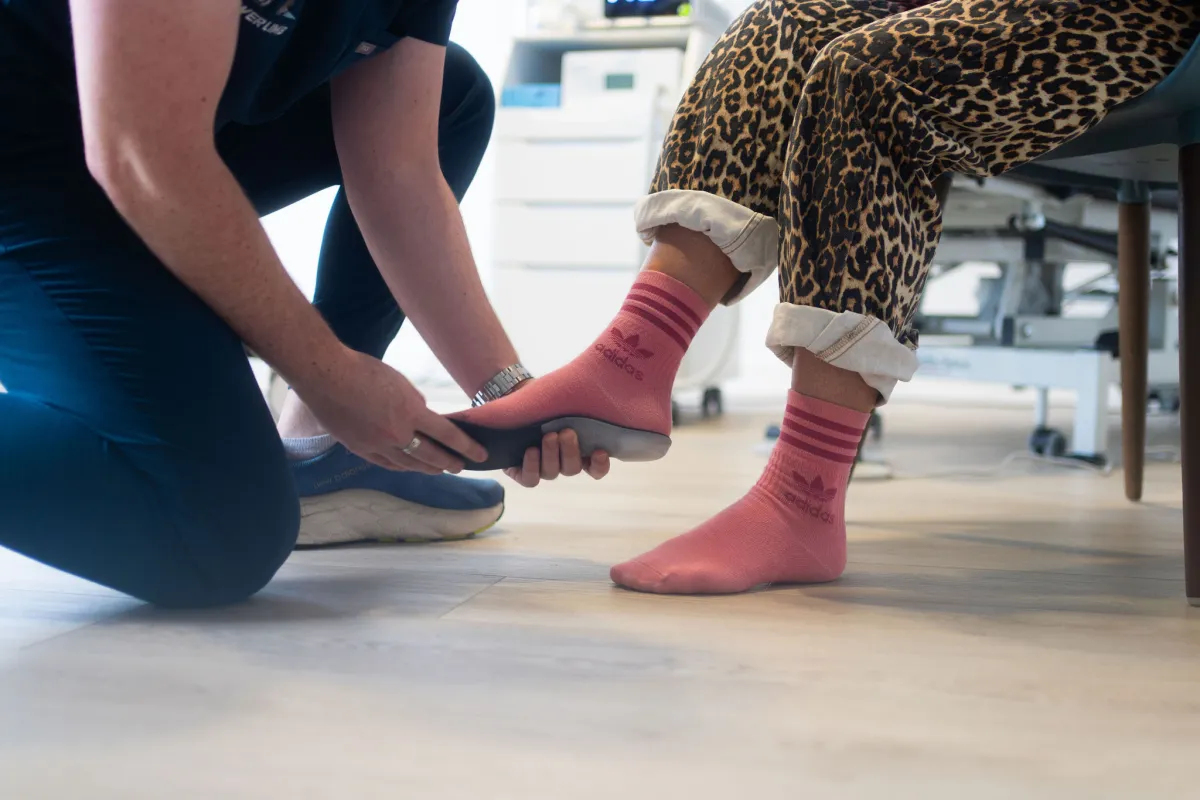
Fitted in your own shoes in Clontarf and adjusted so it controls the foot without rubbing.
- 5
Review
A follow-up once you have worn it in, with your exercise programme.
Start with the Diagnostic Injury Assessment (45 mins, €160), which includes gait assessment and on-site ultrasound. The brace is charged separately and only prescribed if it is the right option for you. The Dublin clinic runs two days a month, so appointments are limited.
Frequently asked questions
What is a Richie Brace?
The Richie Brace is a custom, hinged ankle foot orthosis (AFO). It combines a moulded foot orthotic with two lightweight uprights and a padded calf cuff, hinged at the ankle. It controls the foot and ankle while still letting the ankle bend when you walk.
Is a Richie Brace good for foot drop?
Yes, for flexible foot drop without strong calf spasticity. The Dynamic Assist version has spring hinges that lift the front of the foot by up to 15 degrees as you step, so the toes clear the ground. If there is strong spasticity or a stiff ankle, a more rigid AFO is usually better.
Can a brace help adult acquired flat foot without surgery?
Often, yes, in the early and flexible stages. Research shows that an orthosis combined with a strengthening programme gives a successful outcome for most patients with early posterior tibial tendon dysfunction (83% in Alvarez et al., Foot & Ankle International, 2006). Rigid, advanced cases usually need a surgical opinion, and the brace is then used for support and pain relief.
Will a Richie Brace fit in my shoes?
Most lace-up shoes and trainers with a removable insole will take it. Some people go up half a size. Slip-on shoes, court shoes and sandals generally will not work.
Is it bulky?
No. It is much lower-profile and lighter than a traditional rigid AFO, sits inside the shoe, and the ankle still moves.
Is it off the shelf?
No. Each Richie Brace is made to order from a 3D scan of your foot and lower leg, to a prescription based on your assessment.
Do I wear it all day?
Mainly when you are on your feet and walking. We build your wear time up gradually over the first couple of weeks so your skin and muscles adapt.
Do I need a referral?
No. You can book directly online. If your foot drop is new or unexplained, we will also advise you on getting the cause investigated.
References: Alvarez RG et al. Foot Ankle Int. 2006;27(1):2-8. Kulig K et al. Phys Ther. 2009;89(1):26-37. This page is general information, not medical advice. If you have new weakness in your foot or leg, seek medical assessment promptly.